
September 20, 2009 5:30 PM MDT
You will soon be paying under $2 per gallon again for gasoline and diesel fuel and crude oil will go back down into the 40's. So you can make plans for that trip to see the grandparents for the holidays as well as give the economy a much needed boost. Demand for gasoline in the United States typically falls after Labor Day due to vacation season ending. For the week ending September 4, 2009 demand for gasoline was at its lowest point since January 9, 2008 according to MasterCard Advisors LLC.
Inversion of diesel fuel versus gasoline prices has not been the case in the United States since the Rita and Katrina hurricanes hit the Gulf Coast in August 2005. That event had a major long term impact on inventories of gasoline, distillates and lube stocks on both side of the border. About 25% of the U.S. refinery capacity is located on the Gulf and was severely affected by the weather phenomenon.
Money has been poured into the commodities markets recently as the U.S. dollar fell against the Euro. Crude oil prices have risen from a low of $33 to $72 a barrel last week.
For month investors months have used crude oil as their hedge against inflation, betting that oil prices will likely increase as the economy improves and global supplies start to shrink.
So far 2009 has turned into the first normal year for the petroleum markets since 2004 due to the absence of the high roller speculators and adverse weather conditions. Those investors were burned in the big oil price freefall during the second half of 2008 by following bad advice from their investment brokers.
In August 2009 the U.S. Security and Exchange Commission took initial steps to enforce the strict limitations on dealings between bankers and stock analysts. The law requires investment firms to engage in “fair dealings with customers” and prohibits in-house analysts from issuing opinions and research reports that are at odds with their true beliefs about the market. These opinions are spread fast, far and wide utilizing today’s high tech communications.
The market is also very nervous after news that the Chicago Mercantile Exchange (CME) Group, which runs the New York Mercantile Exchange (NYMEX), notified traders and brokers of tighter enforcement of existing position limits on NYMEX, CME, and other exchanges as of September 14, 2009.
US oil refiners, who were producing diesel in record numbers last year, reversed course earlier this year and made their refining stream fall in line with the flat demand for gasoline and the ever shrinking demand for diesel fuel. Refinery runs have drifted down to 86.94% of capacity from the previous week's 87.2%. Inventories of crude oil and its finished products are at all time high.
That will have the affect of starting the downward slide for gasoline and diesel fuel prices with the price of crude oil following right along.
Bob van der Valk is the Director of US Branded Licensing and Fuel-Pricing Analyst with 4Refuel Inc. in Lynnwood, Washington and can be contacted at (425) 216-9072 or by email at bvan@4refuel.com and web site: http://www.4refuel.com/
Bob’s professional web site is: www.4vqp.com/ourconsultants/thegasguy.html
Any views expressed in this newsletter are those of the writer, except where the writer specifically states them to be the views of the 4Refuel group of companies.
Showing posts with label API. Show all posts
Showing posts with label API. Show all posts
Monday, September 21, 2009


Thursday, September 3, 2009
Gas prices will fizzle out by October
The van der Valk Gas Price Advisory for September 1, 2009
Dateline: Terry, Montana
We have had some dog days here in Terry, Montana this summer and the price of gasoline has been scorching upward right along with the heat. The spot market for gasoline and diesel prices dropped like a rock Monday, but Tuesday morning brought new hope and both of them are both back up. Gasoline is heading the pack but the price of crude oil is back down some more to $68.05 down $1.91 a barrel for the day.
For a further explanation on why gasoline prices are going up while we are still suffering from a recession we look toward the stalwart of all banking institutions, Bank of America (BAC), and its subsidiary Merrill Lynch.
In a report to investors Francisco Blanch, head of commodities research at Merrill Lynch, said that investors are flocking back into commodities after substantial withdrawals in the second part of last year, on the back of rising prices and a recovery in risk appetite.
"Our estimates put the total amount of money currently invested in commodity indices at about $125 billion, up from a trough of $80 billion dollars in February," he said.
But it does not explain that people filling up their tanks are paying more and driving less due to a slacking economy. The unemployment rate has almost doubled from 5 % in April 2008 to 9.7 % in July 2009 per today's U.S. Bureau of Labor Statistics.
Crude prices have been driven higher since the first of this year by a combination of OPEC capacity cuts and continued strong demand from Asia, particularly China and India. China’s oil demand in July increased 3.5% over the same period last year as imports continue to rise. This has pushed the price of crude up even though consumption is down around the world. But the winter months will exacerbate this already clouded picture with crude oil expected to steep downward from the current $70 to $40 a barrel.
Crude oil and gasoline prices will be scorchers for just another month and like comets fizzle out over the horizon with a trail of rocks tailing behind. Fall will bring welcome relief to the exhausted gasoline consumers. The other good news they will be enjoying is lower heating oil and natural gas prices. Diesel prices will move down with crude oil prices and red dye diesel will be down to $1.50 per gallon in time for a cold winter predicted for most of the country. There seems to be no floor on the price of natural gas, which is now at around $2.50 per million cubic feet versus $16.25 just a year ago.
Tuesday, August 11, 2009
Why have crude oil and gasoline doubled in price this year?
Dateline: Terry, Montana
August 10, 2009 12.30 PM MDT
Gas prices are up 14 cents per gallon in the last 10 days across the country but crude oil has remained steady around $70 a barrel since the beginning of July. The American Petroleum Institute’s spokesman John Felmy would like you to reason that when the price of crude oil fluctuates up or down, it will have the same affect on the pump price for gasoline. However, that has not been the case so far in 2009.
The benchmark price for WTI crude oil decreased $1.00 on Friday, August 7th, to $70.93 a barrel after reaching an intra day high of $72.84 a barrel. There was no like response downward in the price for gasoline at U.S. and Canadian gas stations. In fact, gasoline prices have been going steadily upward and crude oil has followed instead of the other way around.
While U.S. gasoline demand usually reaches its ultimate level from June through August, refiners have on the other hand cut production in the three weeks ending July 31. Gasoline stockpiles on that date were 2.9 percent higher than a year earlier, while diesel stocks were 24 percent higher.
The US Energy Information Agency (EIA) reported that total daily fuel use averaged 18.9 million barrels in the four weeks ended July 31, which was 3.1 percent less than a year earlier. However, that is a deceptive number since it includes diesel and jet fuel demand, which has been as much as 20% below last year’s level.
Summer gasoline use is actually on the upswing and will reach its peak demand by Labor Day. This year the holiday weekend falls on September 7th well into the month in which refiners will be switching from producing summer to winter gasoline grade gasoline. That alone has in immediate affect on supply and brings about additional 10 percent of gasoline into the market. Refiners can produce an average of 22 gallons during the winter from a 42 gallon barrel of crude oil versus just 20 gallons out of that same barrel during the summer.
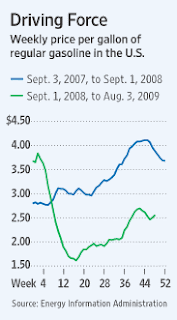
That is good for the consumers but bad for the oil refiners. They will be stuck in the same cycle that occurred last year with gasoline prices and crude oil prices going to a virtual free fall with profits turning into losses. The EIA chart below shows the history of US gasoline prices for the last two years. We started last year out at about $3 then increased to $4.15 per gallon by August. This year we began at $1.55 and went to $2.70 in that same time span.
The Organization of Petroleum Exporting Countries (OPEC) is scheduled to have its next meeting on September 9th with crude oil prices currently hovering around $70 a barrel. That price was quoted as “not bad” and necessary to maintain investment according to OPEC President Botelho de Vasconcelos in Angola over the weekend. OPEC is responsible for 40 percent of global supplies of crude oil and will be reviewing production targets for member countries at their next meeting.
Their big bug-a-boo will be how to handle the massive cheating by some of their members who are exceeding their assigned quotas. July estimates leave the OPEC-11 about one million barrels in excess of the total assigned quota of 25 million barrels of output per day in order to be in compliance with the about 4 million barrels per day crude output agreed upon last year.
August 10, 2009 12.30 PM MDT
Gas prices are up 14 cents per gallon in the last 10 days across the country but crude oil has remained steady around $70 a barrel since the beginning of July. The American Petroleum Institute’s spokesman John Felmy would like you to reason that when the price of crude oil fluctuates up or down, it will have the same affect on the pump price for gasoline. However, that has not been the case so far in 2009.
The benchmark price for WTI crude oil decreased $1.00 on Friday, August 7th, to $70.93 a barrel after reaching an intra day high of $72.84 a barrel. There was no like response downward in the price for gasoline at U.S. and Canadian gas stations. In fact, gasoline prices have been going steadily upward and crude oil has followed instead of the other way around.
While U.S. gasoline demand usually reaches its ultimate level from June through August, refiners have on the other hand cut production in the three weeks ending July 31. Gasoline stockpiles on that date were 2.9 percent higher than a year earlier, while diesel stocks were 24 percent higher.
The US Energy Information Agency (EIA) reported that total daily fuel use averaged 18.9 million barrels in the four weeks ended July 31, which was 3.1 percent less than a year earlier. However, that is a deceptive number since it includes diesel and jet fuel demand, which has been as much as 20% below last year’s level.
Summer gasoline use is actually on the upswing and will reach its peak demand by Labor Day. This year the holiday weekend falls on September 7th well into the month in which refiners will be switching from producing summer to winter gasoline grade gasoline. That alone has in immediate affect on supply and brings about additional 10 percent of gasoline into the market. Refiners can produce an average of 22 gallons during the winter from a 42 gallon barrel of crude oil versus just 20 gallons out of that same barrel during the summer.
That is good for the consumers but bad for the oil refiners. They will be stuck in the same cycle that occurred last year with gasoline prices and crude oil prices going to a virtual free fall with profits turning into losses. The EIA chart below shows the history of US gasoline prices for the last two years. We started last year out at about $3 then increased to $4.15 per gallon by August. This year we began at $1.55 and went to $2.70 in that same time span.

The Organization of Petroleum Exporting Countries (OPEC) is scheduled to have its next meeting on September 9th with crude oil prices currently hovering around $70 a barrel. That price was quoted as “not bad” and necessary to maintain investment according to OPEC President Botelho de Vasconcelos in Angola over the weekend. OPEC is responsible for 40 percent of global supplies of crude oil and will be reviewing production targets for member countries at their next meeting.
Their big bug-a-boo will be how to handle the massive cheating by some of their members who are exceeding their assigned quotas. July estimates leave the OPEC-11 about one million barrels in excess of the total assigned quota of 25 million barrels of output per day in order to be in compliance with the about 4 million barrels per day crude output agreed upon last year.
You can join the crowd if you are totally confused by all the facts and figures you are reading and hearing on exactly what drives gasoline prices. Yesterday morning I joined a couple of elderly ladies for a cup of coffee at a snack bar table during the Ranch Rodeo being held at the Prairie County Fairgrounds in my hometown of Terry, Montana.
Inevitably, the subject of gasoline prices came up and they wanted to know how they ended up paying almost $1.25 per gallon more at the Four Corners gas station in town since earlier this year. After trying to explain it to them they just rolled their eyes and one of them said that it was just the greedy oil companies making money.
Thursday, June 18, 2009
The insider’s secret on how gasoline is priced
Dateline: Terry, Montana
June 18, 2009 11:00 AM MDT
By: Bob van der Valk
After emigrating to the U.S. from Holland, at the young age of 15, I learned to speak English by watching Saturday morning cartoons and listening to Elvis Presley songs on the radio.
English was a mysterious language to me and it took a while before I caught on to the finer nuances of speaking English. The kids at North Miami High School in Florida thought that my Bugs Bunny and Elvis Presley voice impressions were a riot and I l quickly was able some good friends.
The U.S. and Canadian motoring public learn much about the cause of the wild gas price gyrations from the same type of sources.
Crude oil prices are usually made out to be the culprit and blamed by the media for the gas price roller coaster rides. But is not the only factor in the current round of fuel price spikes. Today gas prices tend to influence and support crude oil prices. That opinion runs counter to the conventional view that crude oil drives gasoline prices.
It is the inverse of what occurred with fuel prices in 2007 and early 2008 in the petroleum industry. Since August last year, fuel prices have been driving crude oil prices up and down.
It is my prediction that crude oil may hit $85 in the near term and then ebb back down to $40 by the fall of this year. By Christmas 2009 the price of gasoline in the U.S. should be around $2 per gallon with Canada at 90 cents per liter.
In early August 2008, I made a forecast, published in the Pasadena (CA) Star News, that crude oil and gasoline prices would go down in the last part of 2008. In August, crude oil was still hovering around $140 a barrel and gasoline was over $4 a gallon in the U.S.
By December 2008 the average price of crude oil was $33 a barrel and gasoline was at $1.60 per gallon. That severe drop was aggravated by the economy’s plunge into its recession along with the financial crisis.
I made a prediction in the January 2009 that gas prices would hit $3 per gallon again by the summer as quoted in the following article:
http://www.insidesocal.com/news247/2009/01/gas-prices-could-reach-3-by-su.html
I have been in the petroleum industry for almost 50 years with all that time spent in the refining and marketing (R & M) end of the business. In my early career I worked in the retail and wholesale departments for Union Oil Company of California a.k.a. Unocal in Los Angeles. This should qualify me as the ultimate insider and expert on the way the petroleum industry prices gasoline.
The U.S. petroleum industry has returned to the basics of refining crude oil into gasoline. Major oil companies have the ability to explore and produce for crude oil and bring it up out of the ground for around $40 a barrel. Any amount over that price is pure profit to the oil companies.
The competitive battle between Exploration & Production (E &P) and R & M managers at the oil companies is back on. Each cannot stand to see the other make all the profits for their company.
In the days before the price of crude oil became paper driven, the R & M department used to have knockdown-drag out fights with the E & P department about the price of crude oil delivered to our refinery gate. In those days, they would price crude oil based on price posted at the well plus transportation costs. R & M would then add the cost to refine the crude into fuels and add the marketing cost to determine the wholesale or dealer tank wagon prices.
Today, they take the easy way out and relate their refinery gate crude oil price to the West Texas Intermediate (WTI) crude oil price plus or minus a discount for quality and location. For instance, the posted price for Elm Coulee crude oil in Richland, Montana is currently fetching the WTI daily posted price less $10 a barrel at the well head. R & M still has to add their costs to that price and relate that to the current wholesale and retail prices in order to stay competitive.
In March of 2001 Tom O’Malley, then CEO of Tosco, got tired of losing money for part of the year then trying to make it back during the spring time and summer driving seasons. He announced to his refining and marketing management team at a company meeting in their Phoenix headquarters, that they would tie their retail prices to the wholesale spot market price for gasoline and diesel.
The petroleum market is driven by trades in paper barrels for crude oil and finished products on the New York Mercantile Exchange (NYMEX). That in turn gives indications to the spot market and it has become a case of the tail wagging the dog.
The other major oil companies soon followed suit and since then the pipeline spot market has been driving fuel prices up and down. Today’s gasoline prices are based on a “What the market will bear” strategy by the major oil companies. In the 4th quarter of 2008 and 1st quarter of 2009 refineries lost big time money. Some of them, including the Big West refinery in Bakersfield, were forced to close down due to poor economics. This trend will continue as long as the big money investors stay on the sidelines and cause more havoc in the petroleum markets.
Goldman Sachs & Co., Morgan Stanley and other large investors are able to sidestep regulations that limit investments in commodities such as crude oil. They are investing on behalf of pension funds, endowments, hedge funds and other big institutional investors, in part as a hedge against rising inflation. Crude oil investment is used to offset the weaker dollar with the money going back and forth as the world economy continues its slow recovery
A stream of financial deregulation under the Clinton administration, culminated in the Commodity Futures Modernization Act of 2000. These over-the-counter markets are 10 times larger than the futures market with no position limits and almost no regulations to control their investments.
I have now revealed my secrets on the mystery of fuel pricing to you. I hope that the answer is as simple as watching those Saturday morning cartoons in order to learn to speak English.
Bob van der Valk is the Director of US Branded Licensing with 4Refuel Inc. in Lynnwood, Washington and can be contacted at (971) 678-2975 or by email at: tridemoil@aol.com
Bob’s web site address is: www.4vqp.com/ourconsultants/thegasguy.html
Any views expressed in this newsletter are those of the writer, except where the writer specifically states them to be the views of the 4Refuel group of companies.
June 18, 2009 11:00 AM MDT
By: Bob van der Valk
After emigrating to the U.S. from Holland, at the young age of 15, I learned to speak English by watching Saturday morning cartoons and listening to Elvis Presley songs on the radio.
English was a mysterious language to me and it took a while before I caught on to the finer nuances of speaking English. The kids at North Miami High School in Florida thought that my Bugs Bunny and Elvis Presley voice impressions were a riot and I l quickly was able some good friends.
The U.S. and Canadian motoring public learn much about the cause of the wild gas price gyrations from the same type of sources.
Crude oil prices are usually made out to be the culprit and blamed by the media for the gas price roller coaster rides. But is not the only factor in the current round of fuel price spikes. Today gas prices tend to influence and support crude oil prices. That opinion runs counter to the conventional view that crude oil drives gasoline prices.
It is the inverse of what occurred with fuel prices in 2007 and early 2008 in the petroleum industry. Since August last year, fuel prices have been driving crude oil prices up and down.
It is my prediction that crude oil may hit $85 in the near term and then ebb back down to $40 by the fall of this year. By Christmas 2009 the price of gasoline in the U.S. should be around $2 per gallon with Canada at 90 cents per liter.
In early August 2008, I made a forecast, published in the Pasadena (CA) Star News, that crude oil and gasoline prices would go down in the last part of 2008. In August, crude oil was still hovering around $140 a barrel and gasoline was over $4 a gallon in the U.S.
By December 2008 the average price of crude oil was $33 a barrel and gasoline was at $1.60 per gallon. That severe drop was aggravated by the economy’s plunge into its recession along with the financial crisis.
I made a prediction in the January 2009 that gas prices would hit $3 per gallon again by the summer as quoted in the following article:
http://www.insidesocal.com/news247/2009/01/gas-prices-could-reach-3-by-su.html
I have been in the petroleum industry for almost 50 years with all that time spent in the refining and marketing (R & M) end of the business. In my early career I worked in the retail and wholesale departments for Union Oil Company of California a.k.a. Unocal in Los Angeles. This should qualify me as the ultimate insider and expert on the way the petroleum industry prices gasoline.
The U.S. petroleum industry has returned to the basics of refining crude oil into gasoline. Major oil companies have the ability to explore and produce for crude oil and bring it up out of the ground for around $40 a barrel. Any amount over that price is pure profit to the oil companies.
The competitive battle between Exploration & Production (E &P) and R & M managers at the oil companies is back on. Each cannot stand to see the other make all the profits for their company.
In the days before the price of crude oil became paper driven, the R & M department used to have knockdown-drag out fights with the E & P department about the price of crude oil delivered to our refinery gate. In those days, they would price crude oil based on price posted at the well plus transportation costs. R & M would then add the cost to refine the crude into fuels and add the marketing cost to determine the wholesale or dealer tank wagon prices.
Today, they take the easy way out and relate their refinery gate crude oil price to the West Texas Intermediate (WTI) crude oil price plus or minus a discount for quality and location. For instance, the posted price for Elm Coulee crude oil in Richland, Montana is currently fetching the WTI daily posted price less $10 a barrel at the well head. R & M still has to add their costs to that price and relate that to the current wholesale and retail prices in order to stay competitive.
In March of 2001 Tom O’Malley, then CEO of Tosco, got tired of losing money for part of the year then trying to make it back during the spring time and summer driving seasons. He announced to his refining and marketing management team at a company meeting in their Phoenix headquarters, that they would tie their retail prices to the wholesale spot market price for gasoline and diesel.
The petroleum market is driven by trades in paper barrels for crude oil and finished products on the New York Mercantile Exchange (NYMEX). That in turn gives indications to the spot market and it has become a case of the tail wagging the dog.
The other major oil companies soon followed suit and since then the pipeline spot market has been driving fuel prices up and down. Today’s gasoline prices are based on a “What the market will bear” strategy by the major oil companies. In the 4th quarter of 2008 and 1st quarter of 2009 refineries lost big time money. Some of them, including the Big West refinery in Bakersfield, were forced to close down due to poor economics. This trend will continue as long as the big money investors stay on the sidelines and cause more havoc in the petroleum markets.
Goldman Sachs & Co., Morgan Stanley and other large investors are able to sidestep regulations that limit investments in commodities such as crude oil. They are investing on behalf of pension funds, endowments, hedge funds and other big institutional investors, in part as a hedge against rising inflation. Crude oil investment is used to offset the weaker dollar with the money going back and forth as the world economy continues its slow recovery
A stream of financial deregulation under the Clinton administration, culminated in the Commodity Futures Modernization Act of 2000. These over-the-counter markets are 10 times larger than the futures market with no position limits and almost no regulations to control their investments.
I have now revealed my secrets on the mystery of fuel pricing to you. I hope that the answer is as simple as watching those Saturday morning cartoons in order to learn to speak English.
Bob van der Valk is the Director of US Branded Licensing with 4Refuel Inc. in Lynnwood, Washington and can be contacted at (971) 678-2975 or by email at: tridemoil@aol.com
Bob’s web site address is: www.4vqp.com/ourconsultants/thegasguy.html
Any views expressed in this newsletter are those of the writer, except where the writer specifically states them to be the views of the 4Refuel group of companies.
Wednesday, May 6, 2009
Happy Cinco de Gaso
It is Cinco de Mayo in the US to celebrate Mexican heritage and pride. We also commemorate this day in Holland as Bevrijdingsdag or Liberation Day. It is celebrated each year on May 5th in the Netherlands (the official name for Holland) to mark the end of the Nazi occupation during World War II.
The nation was liberated by Canadian troops, with the assistance of the British and American armies. After the liberation in 1945, Liberation Day was commemorated every 5 years. Finally, in 1990, the day was declared to be a national holiday with the liberation celebrated every year.
The provinces of Utrecht, North and South-Holland were the last provinces in Holland to be liberated. The population in that area suffered greatly during the winter of 1944-45 from starvation and bombings. My family lived in The Hague, South Holland and was able to survive the hunger winter. We eventually were able to immigrate to the US on special visas issued under the Refugee Relief Act of 1954.
We have been in the US for almost 53 years and I have spent 50 of those working in the petroleum business. My family was fortunate to have been given the opportunity to live and work in this country with its many generous people.
The June WTI crude oil price is down 50 cents back down to below $54 a barrel. The spot market prices for gasoline and diesel are down 2 cents per gallon this morning as well.
The oil traders are now looking ahead to the weekly Department of Energy inventory statistics being published tomorrow morning. Gasoline prices will spike up if they show another big draw for gasoline stocks as they did last week. This will be regardless of crude oil stocks anticipated to increase once more.
May is the typical month in which summer driving season starts. Gasoline prices will be staying firm with lower than normal supplies available. Refineries are also keeping a tight hold on production
OPEC is also providing support for the oil price by indications that they are not happy with $50 a barrel and hinting at further production cuts when they meet later this month in Vienna, Austria. Warren Buffet emerged from his office and sounded positive notes providing support to the raw commodity markets as well.
The nation was liberated by Canadian troops, with the assistance of the British and American armies. After the liberation in 1945, Liberation Day was commemorated every 5 years. Finally, in 1990, the day was declared to be a national holiday with the liberation celebrated every year.
The provinces of Utrecht, North and South-Holland were the last provinces in Holland to be liberated. The population in that area suffered greatly during the winter of 1944-45 from starvation and bombings. My family lived in The Hague, South Holland and was able to survive the hunger winter. We eventually were able to immigrate to the US on special visas issued under the Refugee Relief Act of 1954.
We have been in the US for almost 53 years and I have spent 50 of those working in the petroleum business. My family was fortunate to have been given the opportunity to live and work in this country with its many generous people.
The June WTI crude oil price is down 50 cents back down to below $54 a barrel. The spot market prices for gasoline and diesel are down 2 cents per gallon this morning as well.
The oil traders are now looking ahead to the weekly Department of Energy inventory statistics being published tomorrow morning. Gasoline prices will spike up if they show another big draw for gasoline stocks as they did last week. This will be regardless of crude oil stocks anticipated to increase once more.
May is the typical month in which summer driving season starts. Gasoline prices will be staying firm with lower than normal supplies available. Refineries are also keeping a tight hold on production
OPEC is also providing support for the oil price by indications that they are not happy with $50 a barrel and hinting at further production cuts when they meet later this month in Vienna, Austria. Warren Buffet emerged from his office and sounded positive notes providing support to the raw commodity markets as well.
Subscribe to:
Posts (Atom)